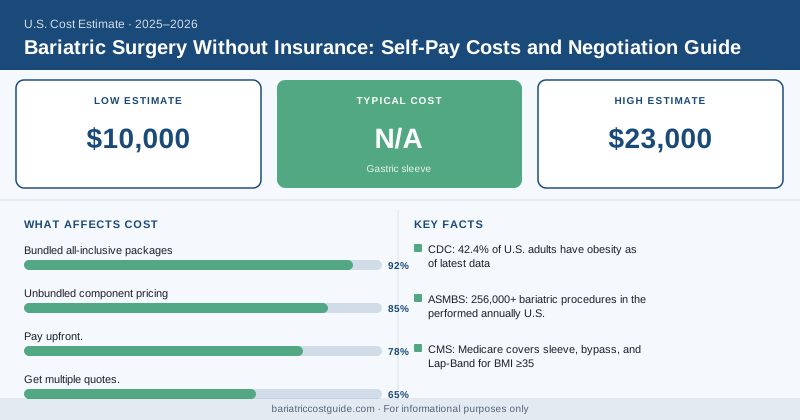
Bariatric Surgery Without Insurance: Self-Pay Costs and Negotiation Guide
{ if eq .Lang "zh" }{ else }{ end }55% of Americans who need bariatric surgery can’t access insurance coverage for it. That’s not a typo — roughly half of commercial health plans still exclude bariatric benefits entirely. If you’re in that group, here’s what you’ll actually pay and how to get the best price.
Self-pay bariatric surgery runs from $10,000 for a basic sleeve gastrectomy at a high-volume center to $30,000+ for gastric bypass at a premium urban hospital. The range isn’t random, and you have real leverage to negotiate — if you know how.
Self-Pay Costs by Procedure
| Procedure | Self-Pay Low | Self-Pay Mid | Self-Pay High |
|---|---|---|---|
| Gastric sleeve | $10,000 | $15,000 | $23,000 |
| Gastric bypass (RYGB) | $15,000 | $22,000 | $35,000 |
| Duodenal switch / SADI-S | $18,000 | $27,000 | $40,000 |
| Gastric balloon | $6,000 | $9,000 | $15,000 |
| Endoscopic sleeve (ESG) | $10,000 | $14,000 | $20,000 |
| Sleeve in Mexico | $4,000 | $6,000 | $8,000 |
How Self-Pay Pricing Actually Works
When you’re paying cash, there are two completely different pricing systems in play:
Bundled all-inclusive packages are offered by most high-volume bariatric programs. One price covers the surgeon, the facility, anesthesia, pre-op labs, psychological evaluation, nutritional counseling, and typically 1–2 years of post-op follow-up. These are usually offered only to self-pay patients at rates 20–40% below what insurance gets billed.
Unbundled component pricing is what happens at hospitals that don’t have formal self-pay programs. You get separate bills from the surgeon, the hospital, the anesthesiologist, and possibly a lab. Each bill can be negotiated individually, but the process is much more complex and the total often ends up higher.
Always ask for the bundled all-inclusive self-pay package first.
Negotiating Self-Pay Rates
Bariatric surgery centers have significant margin in their pricing and real incentive to work with self-pay patients. Here’s what actually moves the needle:
Pay upfront. Centers discount for upfront payment because it eliminates billing risk and carrying costs. Ask: “If I pay the full amount before the surgery date, what’s your best price?” Discounts of 10–25% are common.
Get multiple quotes. Call 3–4 MBSAQIP-accredited centers in your market. Prices for the same procedure vary significantly even within the same city. Use competing quotes as leverage.
Ask what’s included. Before comparing prices, confirm each quote includes the same elements — surgery, anesthesia, facility, pre-op, post-op follow-up for 1 year. A $12,000 quote that excludes pre-op labs, psych eval, and follow-up may actually cost more than a $15,000 all-inclusive package.
Ask about hardship discounts. Some programs have formal financial hardship applications that unlock deeper discounts for patients who document financial need. Ask the bariatric coordinator directly.
The MBSAQIP Accreditation Requirement Still Applies to Self-Pay
Don’t trade accreditation for price. MBSAQIP-accredited centers have demonstrated quality standards: trained surgical teams, appropriate equipment, and structured follow-up programs. Complication rates at accredited centers run 1–3%; at non-accredited facilities, complication rates can be 2–5x higher.
A $2,000 savings at a non-accredited center isn’t worth it if it increases your risk of a $50,000 complication. Verify MBSAQIP accreditation for any center you’re considering at the MBSAQIP.com directory.
Financing Self-Pay Surgery
Most bariatric programs have financing options for self-pay patients:
CareCredit: The most widely accepted medical credit card. Offers 0% promotional periods of 12–24 months for procedures over certain dollar amounts. After the promotional period, rates jump to 26.99% APR — so pay it off before then.
Prosper Healthcare Lending: Medical loans specifically for bariatric surgery. Fixed interest rates (typically 7–28% APR), terms up to 84 months. Better for patients who need longer repayment periods.
Hospital-based payment plans: Some programs offer in-house financing at 0% interest for 12–24 months. Ask specifically — these aren’t always advertised.
Home equity: For homeowners, a HELOC or home equity loan offers lower interest rates than medical financing. Rates as of 2025–2026 run 7–9%, lower than most medical loan options.
When Medical Tourism Makes Financial Sense
For self-pay patients, Mexico is often the most cost-effective option for sleeve gastrectomy. A $4,000–$8,000 sleeve at a reputable Tijuana or Monterrey center versus $15,000 in the U.S. is a $7,000–$11,000 difference.
The math works if: you choose a CAHOBC-accredited facility (Mexico’s equivalent of MBSAQIP), your surgeon has board certification (ideally both Mexican and U.S. training), and you have a clear plan for follow-up care with a U.S. physician if complications occur.
The math doesn’t work if you cut corners on accreditation or get complications requiring U.S. emergency care — an unplanned U.S. hospital readmission can cost $20,000–$50,000.
The Bottom Line
Self-pay bariatric surgery costs $10,000–$35,000 in the U.S., but bundled all-inclusive packages with upfront payment discounts can bring real costs down to $10,000–$18,000 for sleeve gastrectomy at accredited centers. Get multiple quotes, ask specifically for self-pay package pricing, use HSA/FSA funds if available, and evaluate medical tourism only at accredited facilities with strong follow-up protocols. The price is real but negotiable — and surgery’s long-term health economics almost always outperform indefinite GLP-1 medication costs.
{ if eq .Lang "zh" }Disclaimer: BariatricCostGuide provides cost data for educational purposes only. We are not a medical provider, insurance company, or financial advisor. All costs are estimates based on published data and vary by location, facility, surgeon, insurance plan, and individual health factors. Consult a board-certified bariatric surgeon and your insurance carrier for personalized medical and cost advice.