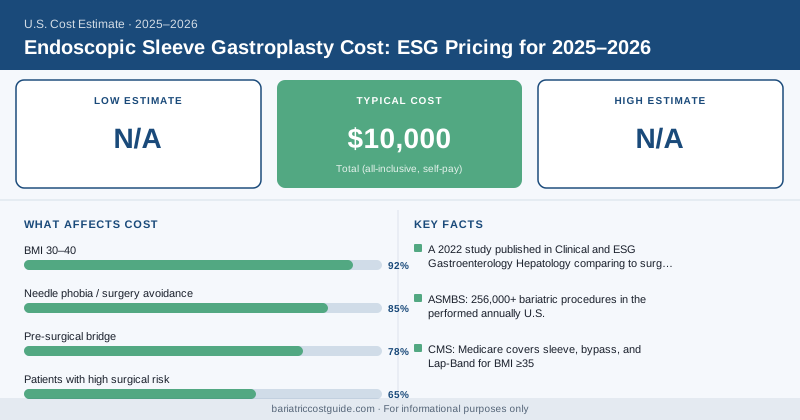
Endoscopic Sleeve Gastroplasty Cost: ESG Pricing for 2025–2026
{ if eq .Lang "zh" }{ else }{ end }No incisions. No hospital stay. Back home the same day. That’s the pitch for endoscopic sleeve gastroplasty — and it’s accurate. What it doesn’t tell you is that ESG costs nearly as much as surgical sleeve, with meaningfully less weight loss.
Endoscopic sleeve gastroplasty (ESG) uses an endoscope with a suturing device — typically the Apollo Endosurgery OverStitch system — to fold and stitch the stomach from the inside, reducing its volume by about 70–80% without any external incisions. It’s performed under general anesthesia in an outpatient endoscopy suite and takes about 60–90 minutes.
What ESG Costs in 2025–2026
Self-pay costs for endoscopic sleeve gastroplasty run $10,000 to $20,000 in the U.S. Most programs charge $12,000–$16,000 as a bundled all-inclusive price.
| Cost Component | Typical Range |
|---|---|
| Physician/endoscopist fee | $3,000 – $6,000 |
| Endoscopy suite/facility fee | $5,000 – $10,000 |
| Anesthesia | $1,000 – $2,500 |
| Behavioral counseling and follow-up | $500 – $1,500 |
| Total (all-inclusive, self-pay) | $10,000 – $20,000 |
ESG vs. Surgical Sleeve: The Honest Comparison
The critical question: why pay $10,000–$20,000 for ESG when surgical sleeve gastrectomy offers better results for roughly similar cost?
The answer depends on what you’re optimizing for. ESG trades weight loss efficacy for lower procedural risk and faster recovery.
A 2022 study published in Clinical Gastroenterology and Hepatology comparing ESG to surgical sleeve at 24 months found ESG patients lost 49% of excess weight vs. 67% for surgical sleeve — a significant gap. But ESG’s major adverse event rate was 2.2% vs. 4.1% for surgical sleeve, and ESG patients returned to normal activities in 3–5 days instead of 2–4 weeks.
| Factor | ESG | Surgical Sleeve |
|---|---|---|
| Typical cost | $10,000 – $20,000 | $10,000 – $23,000 |
| Excess weight loss (2 yr) | 45–55% | 60–70% |
| Hospital stay | None (outpatient) | 1–2 days |
| Recovery time | 3–5 days | 2–3 weeks |
| Incisions | None | 5 small laparoscopic |
| Reversibility | Theoretically reversible | Irreversible |
| Insurance coverage | Rarely covered | Often covered |
Insurance Coverage: Mostly Excluded
ESG is newer and less well-studied than surgical bariatric procedures, and most insurers still classify it as investigational. Don’t expect coverage.
This is changing slowly. A handful of plans now cover ESG for appropriately documented patients, and ASMBS has stated that ESG is a reasonable option for BMI 30–40 patients who don’t meet surgical criteria. But in 2025–2026, assume you’re paying cash.
HSA and FSA funds can be used for ESG, since the procedure qualifies as a medical expense.
ESG Makes Most Sense for These Patients
ESG is best positioned for:
- BMI 30–40: Patients who don’t meet the BMI ≥ 40 (or ≥ 35 + comorbidity) surgical threshold
- Needle phobia / surgery avoidance: Patients psychologically opposed to traditional surgery
- Pre-surgical bridge: Losing weight before a surgical procedure
- Patients with high surgical risk: Those with cardiac or pulmonary conditions where traditional OR surgery poses elevated risk
ESG is not the right choice for patients who qualify for surgical sleeve or bypass and have insurance coverage — the cost-outcome math favors surgery in that scenario.
What the Apollo OverStitch Procedure Actually Involves
The OverStitch suturing device attaches to the end of a standard endoscope. The physician passes the scope through your mouth, into the stomach, and uses the device to place a series of full-thickness sutures along the greater curvature of the stomach — essentially gathering the tissue like a sleeve and stitching it into a smaller tube shape.
Because it’s done entirely from inside the stomach through the mouth, there are no abdominal incisions and no external scars. The procedure takes 60–90 minutes. You go home the same day with liquid diet instructions and follow up in 1–2 weeks.
Most patients can return to desk work in 3–5 days. Physical activity restarts at 2 weeks.
The Bottom Line
Endoscopic sleeve gastroplasty costs $10,000–$20,000, is almost never covered by insurance, and delivers 45–55% excess weight loss — less than surgical sleeve but with faster recovery and no incisions. It’s the right tool for patients outside the surgical BMI range or those who can’t or won’t undergo traditional surgery. For patients who qualify for surgical sleeve or bypass and have coverage, ESG’s cost-outcome profile generally doesn’t compete.
{ if eq .Lang "zh" }Disclaimer: BariatricCostGuide provides cost data for educational purposes only. We are not a medical provider, insurance company, or financial advisor. All costs are estimates based on published data and vary by location, facility, surgeon, insurance plan, and individual health factors. Consult a board-certified bariatric surgeon and your insurance carrier for personalized medical and cost advice.